1994 Bandai Sailor Mercury Holographic Trading Card

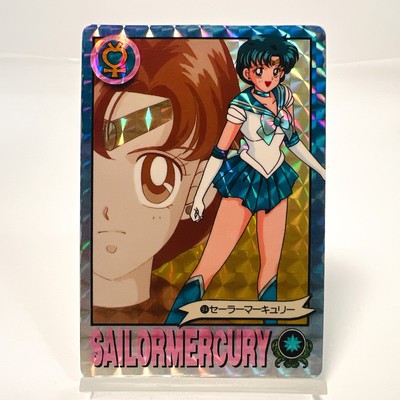
This is a holographic trading card manufactured by Bandai in 1994, featuring Sailor Mercury from the Pretty Guardian Sailor Moon franchise. The card’s surface carries a prism finish that shifts through colors as the viewing angle changes — a premium treatment Bandai reserved for a portion of its Carddass releases, setting them apart from standard printed versions. The card is numbered 4, placing it within a sequenced set, though the exact series name and full card count are not confirmed from the card alone.
Ami Mizuno and the World of Sailor Moon
Sailor Moon began as a manga by Naoko Takeuchi, serialized in Kodansha’s Nakayoshi magazine from 1991 to 1997. The anime adaptation by Toei Animation premiered on TV Asahi in March 1992 and ran across five consecutive series. By 1994 — the year this card was produced — the franchise was transitioning from its second arc, Sailor Moon R, into its third, Sailor Moon S, a period that aligned with the property’s peak domestic momentum.
Sailor Mercury is the first supporting Guardian to join the story, awakening in episode eight of the original series under her civilian name, Ami Mizuno. Her elemental domain covers water and ice, and she is defined by intelligence and composure — the team’s analytical, steadying presence across every arc of the series. Her design is built around blue and teal tones, a distinctive visor, and a head ribbon. This card presents both a close-up portrait of Ami in her everyday appearance and a full-body illustration of her transformed as Sailor Mercury, with the Mercury planetary symbol printed in the upper left corner. Her name appears on the card in both English and Japanese, a bilingual presentation that was common on Japanese merchandise of this era even for products intended primarily for the domestic market.
The Carddass System and Japan’s Card Culture
Bandai launched the Carddass system in 1988 — a network of dedicated vending machines installed in game centers, candy shops, and toy stores across Japan, each dispensing one card per coin for a small amount. The randomized draw made completing a full set a deliberate challenge, which sustained collecting habits among Japanese children throughout the late 1980s and 1990s. Sailor Moon was one of the most actively released titles in the Carddass lineup, with multiple series issued over the course of the franchise.
Holographic cards occupied a distinct tier within that system. They appeared at lower rates than standard versions, making them noticeably harder to obtain and giving them outsized appeal among collectors at the time. Cards like this one — with the shifting, rainbow surface that was difficult and expensive to produce — were the ones children traded for and searched for in machines across Japan.
A Document of 1990s Anime Culture
Now more than thirty years old, this card sits at the intersection of two things that defined an era: the global spread of Sailor Moon and the tactile, coin-fed card-collecting habits of 1990s Japanese childhood. A DiC Entertainment localization brought Sailor Moon to North American screens in 1995, followed by releases across Europe and Asia, and the franchise has sustained an active fan community in all of those regions ever since. For collectors outside Japan, original domestic merchandise carries specific interest as a record of the source material in its home context — Japanese-market artwork, Japanese text, and the particular visual and material character of mid-1990s Bandai production. Sailor Mercury, as one of the most consistently recognized supporting characters across all regions the franchise reached, remains a focus for fans worldwide.


Sleeved and rigid-mailed before it leaves Japan
$8.82
Ships internationally • More photos on the eBay listing